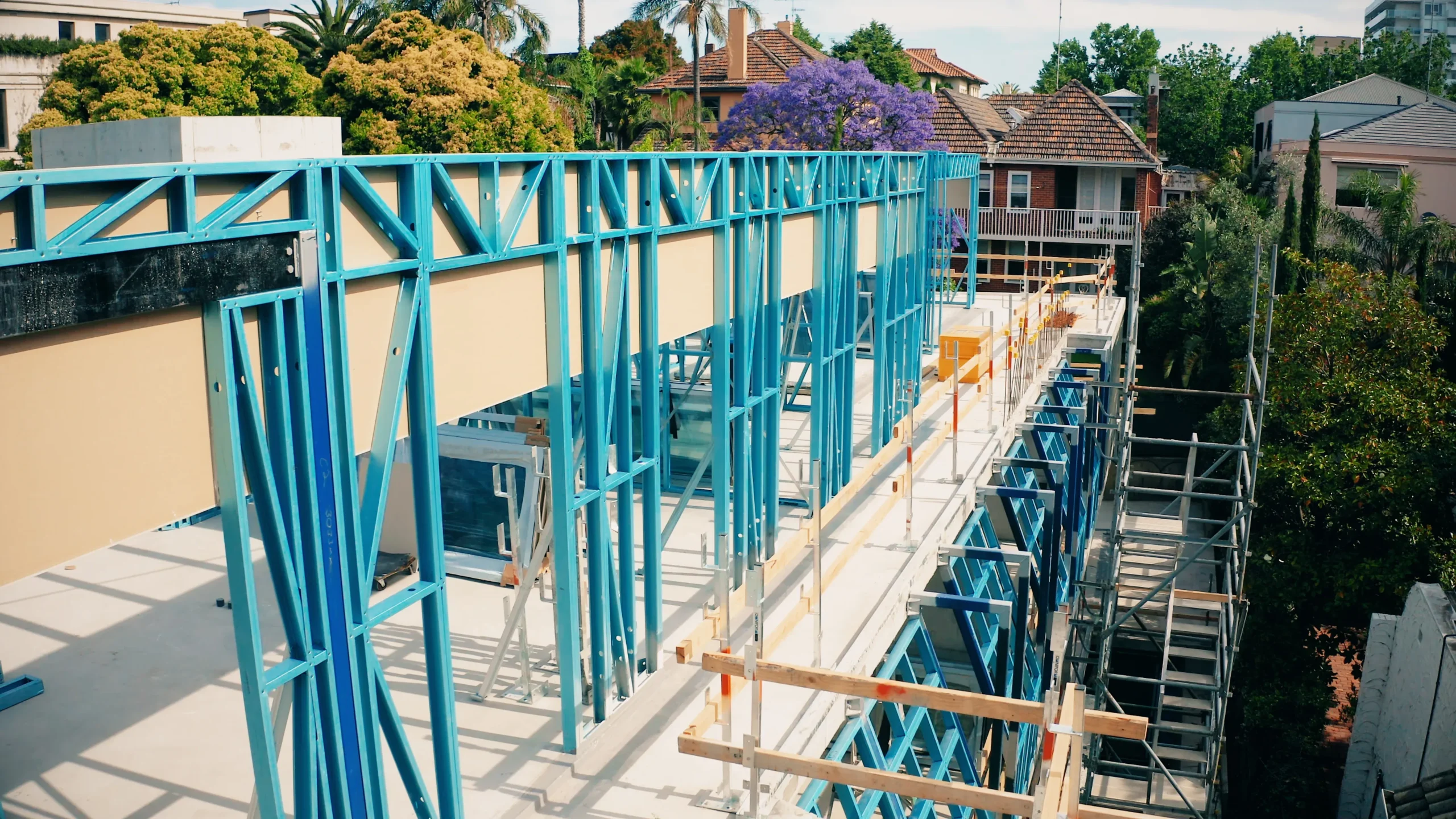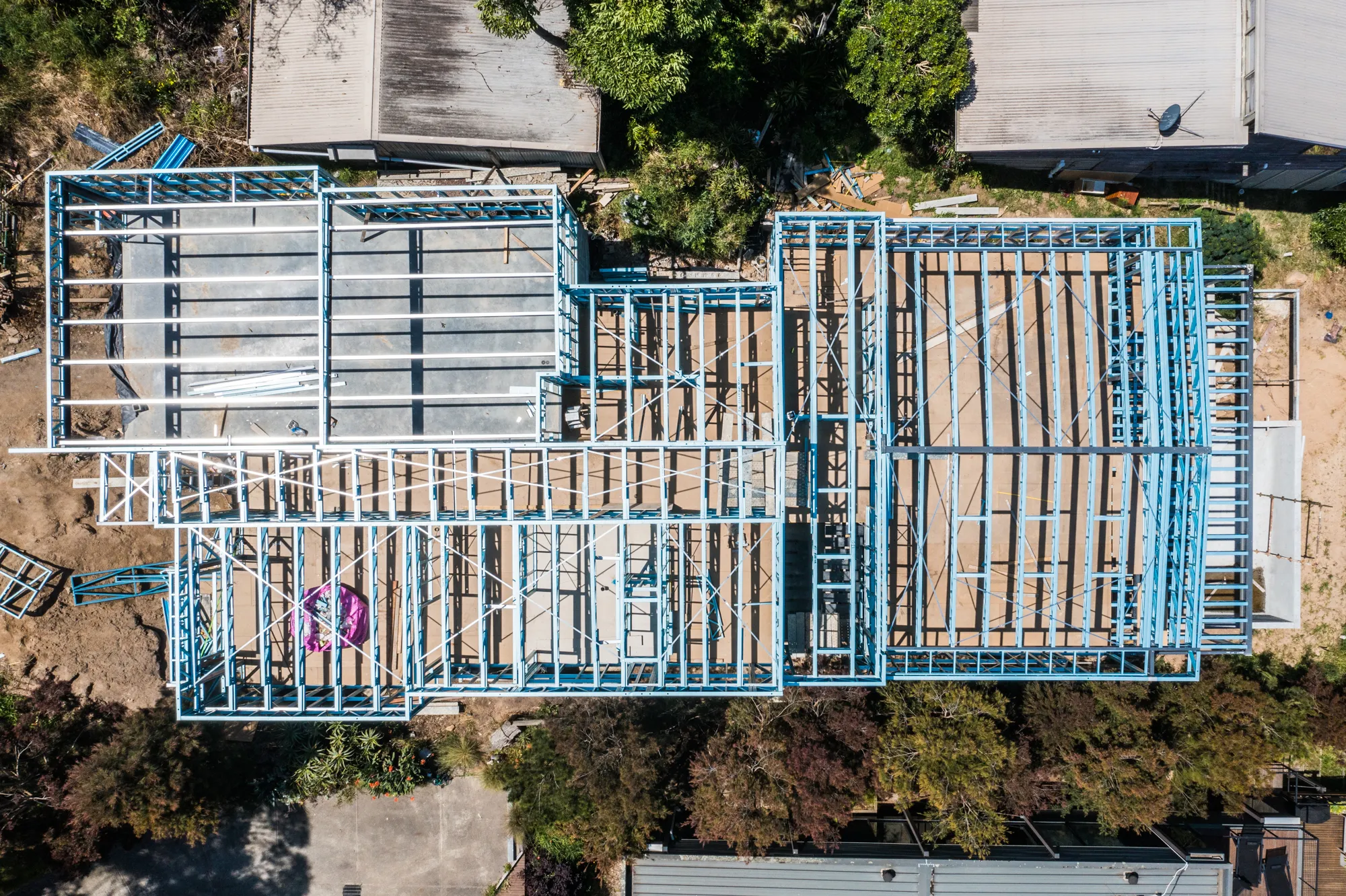

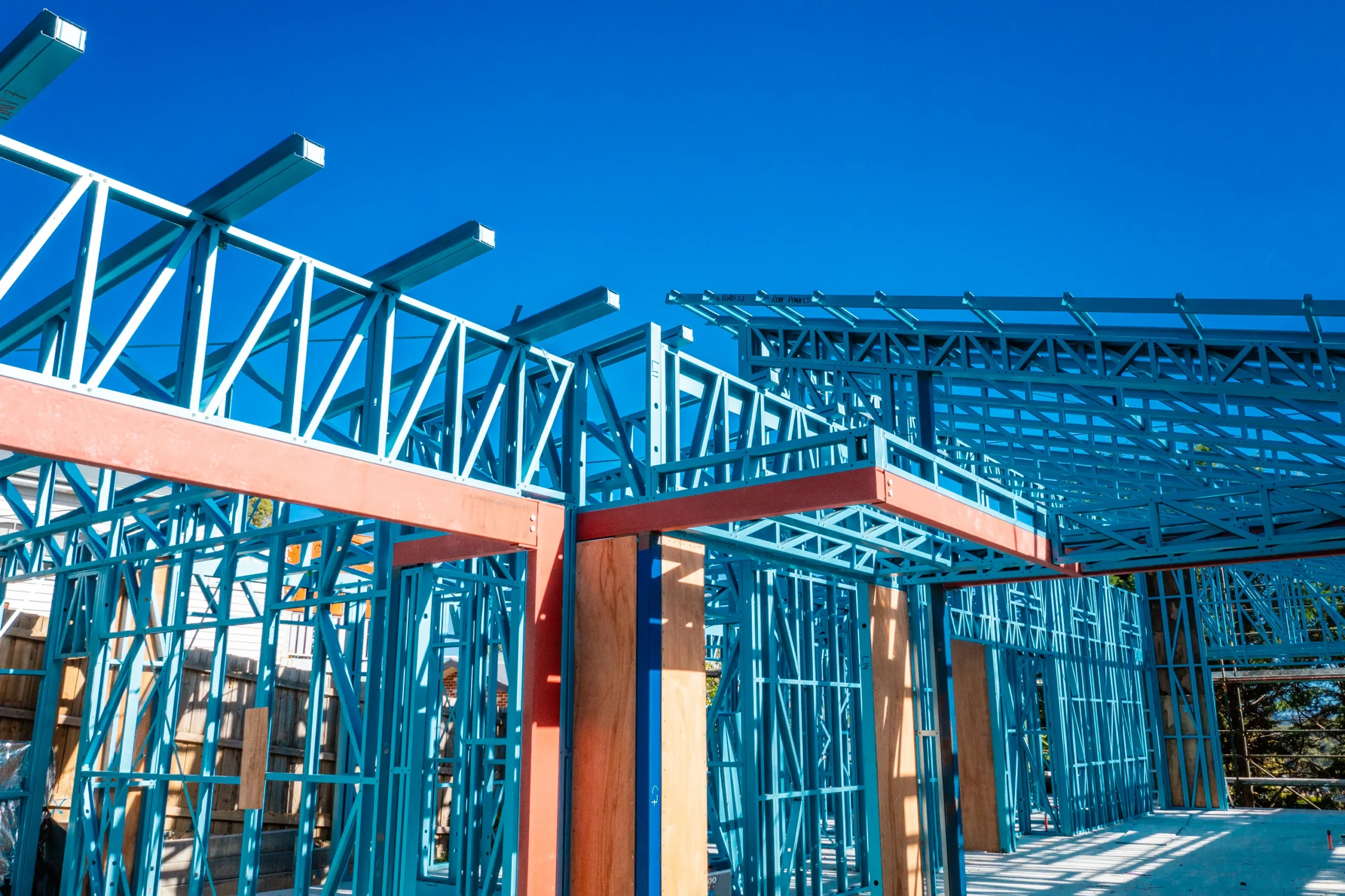
Steel stud framing is the structural and partition wall system that underpins an enormous proportion of Australia’s new residential and commercial construction. Yet for builders with a timber background, the transition to steel stud systems raises questions that can slow projects and erode confidence.
This guide covers everything Australian builders need to know about steel stud framing: how it works, what sizes apply, how it is installed, where it performs best, and what standards govern its use.
Steel stud framing is a wall framing system using cold-formed (roll-formed) steel sections to create structural and non-structural wall panels. The system uses two primary section types:
The stud-and-track system is direct-fit. Studs are cut to length and inserted into the top and bottom tracks, then fixed with screws, clinch fasteners, or welded connections depending on the application and load requirements.
Steel stud framing is designed and manufactured to AS/NZS 4600 Cold-Formed Steel Structures and, for residential applications, to the NASH Standard for Residential and Low-Rise Steel Framing.
Australian steel stud framing uses metric C-section and track sizes. The most commonly used residential and commercial stud sizes are:
Stud Depth | Common Applications |
|---|---|
64 mm | Non-load-bearing internal partitions, short span walls |
70 mm | Non-load-bearing partitions, standard internal walls |
90 mm | Load-bearing walls (residential), commercial partitions requiring insulation clearance |
92 mm | Common residential load-bearing wall stud in many frame systems |
150 mm | Commercial load-bearing walls, external walls requiring higher insulation values |
152 mm | Commercial applications, taller walls, higher wind load situations |
Source: Standard section sizes used in the Australian light gauge steel framing market, referenced from AS/NZS 4600 Cold-Formed Steel Structures and the NASH Standard for Residential and Low-Rise Steel Framing. Available section depths and BMT ratings vary between manufacturers. Confirm section availability and load capacity with your supplier and structural engineer.
Base metal thickness (BMT) varies from 0.55 mm for non-load-bearing light partitions through to 1.15 mm and above for load-bearing commercial applications. Heavier gauge studs (1.15 mm and above) are used in load-bearing walls subject to higher structural loads.
The correct stud size and gauge for any application must be confirmed by a structural engineer based on the wall height, load type, and building classification.
Load-bearing steel stud walls carry vertical loads from the structure above, such as floor joists, roof trusses, or upper floor wall frames, down to the foundations or the floor below. They must be designed by a structural engineer and fabricated from sections of appropriate depth and gauge.
Load-bearing walls require specific connection details at the top and bottom tracks, including stiffeners at bearing points where concentrated loads transfer from joists or beams into the wall.
Non-load-bearing walls carry only their self-weight and the loads from cladding or board finishes applied to their faces. They do not carry structural loads from the floors or roof above. Non-load-bearing walls are used extensively for internal partitioning in commercial buildings.
Non-load-bearing stud walls use lighter sections and simpler connections than structural walls, which reduces material cost and speeds installation.
External steel stud walls carry lateral wind loads as well as supporting the cladding and board systems. They must be designed to transfer wind loads back to the primary structure through horizontal bracing or rigid frame action. External walls also require appropriate flashing and moisture management detailing.
Fire-rated steel stud wall assemblies use specific combinations of stud gauge, board type, and installation method to achieve tested Fire Resistance Levels (FRL). The NASH Standard and the board manufacturer’s installation specifications define the tested assemblies. Fire-rated assemblies are widely used in commercial buildings and in residential buildings where fire separation is required by the NCC.
The question of whether to use steel or timber studs comes up regularly on both residential and commercial projects. Here is a direct comparison on the factors most relevant to Australian builders:
Dimensional consistency: Steel studs are manufactured to precise tolerances. Timber studs vary in straightness, moisture content, and density, and can develop bow or twist after installation as they dry. For plasterboard applications, straight walls and consistent plane alignment are much easier to achieve with steel.
Termite resistance: Steel studs are immune to termite attack. In termite-active areas across much of Australia, using steel studs eliminates the termite risk from the wall framing system entirely.
Fire performance: Steel studs in fire-rated assemblies deliver tested, certified performance. Timber studs in fire-rated assemblies can also achieve tested performance, but steel is the preferred material in commercial applications where non-combustible construction is required.
Ease of cutting: Timber is cut with a saw and requires no further treatment. Steel studs are cut with tin snips, a circular saw with a steel-cutting blade, or an angle grinder. The cut edges of steel studs do not require treatment for corrosion in normal internal applications.
Acoustic performance: Steel stud walls with resilient mounting systems and appropriate insulation achieve excellent acoustic performance. The inherent stiffness of steel stud walls means that acoustic results depend significantly on the isolation of the board system from the structure, which requires correct installation technique.
Weight: Steel studs are lighter than equivalent timber studs, reducing loads on floors and foundations.
Cost: Steel studs typically cost more per stud than equivalent timber. However, the total installed cost difference narrows considerably when the savings from straighter walls, faster board installation, and reduced defect rectification are accounted for.
Mark the wall positions on the floor and ceiling (or underside of the structure above) using chalk lines or laser levels. Accuracy at set out eliminates problems throughout the installation sequence.
Fix the bottom tracks to the floor slab or subfloor using the specified fastener type and spacing. In concrete slab applications, power-actuated fasteners or masonry anchors are typically used. Bottom tracks must be fixed at the centres specified in the engineering drawings.
Fix the top tracks to the ceiling structure or the underside of the floor above. In commercial applications with concrete soffit, this typically requires anchor bolts or power-actuated fasteners. Ensure tracks are plumb over the bottom tracks.
Cut studs to the required height, allowing for the tolerance gap specified in the engineering drawings. Insert studs into the top and bottom tracks. For load-bearing walls, fix studs to tracks using the specified screw pattern. For non-load-bearing walls, a reduced fixity connection may be appropriate to allow for structural deflection above.
Fix noggings (horizontal members between studs) at the heights specified on the drawings. Noggings provide lateral restraint to studs, support for mid-height wall fixtures, and a fixing substrate for sheet edges.
For load-bearing steel stud walls, install diagonal strap bracing or rigid panel bracing as specified by the engineer. Bracing is a structural requirement and must not be omitted or modified on site.
Steel studs have pre-punched service holes (grommets openings) at standard heights for running electrical conduit and hydraulic pipes within the wall. Install grommets in service holes before passing services through the wall to protect cables and pipes from the cut steel edges. See our detailed guide to steel frame grommets for more information.
Fix plasterboard or other board systems to the studs at the screw spacings specified by the board manufacturer’s installation guide. Board screw spacings affect both structural performance and fire rating performance in rated wall assemblies.
Steel studs in Australian residential and commercial construction are typically spaced at:
The correct stud spacing for any application must be confirmed by a structural engineer. Changing stud spacing on site without engineering approval may affect the structural capacity of the wall and the validity of any fire rating tested assembly.
Steel stud framing is the standard system for internal partitioning throughout Melbourne’s commercial building stock, used in:
In multi-storey commercial buildings, steel stud partitioning is often installed in parallel with the primary structure, allowing trades to work on multiple floors simultaneously and compress the overall programme.
Steel stud framing costs vary by project type, wall configuration, and the extent of fire rating and acoustic requirements. Indicative supply-only costs for light gauge steel stud framing in 2025 and 2026:
Residential load-bearing wall frames (supply only):
$18 to $35 per lineal metre of wall, depending on wall height, stud size, and gauge.
Commercial non-load-bearing partitioning (supply only):
$12 to $25 per lineal metre for standard commercial partition framing.
Commercial fire-rated assemblies (supply only):
$25 to $50 per lineal metre depending on the FRL required and board system specified.
Installation costs are additional to these supply figures and depend on labour rates, project access, and installation complexity.
Residential buildings (NCC Class 1 and 10):
Design and installation must comply with NCC Volume Two and the NASH Standard for Residential and Low-Rise Steel Framing. Engineering certification is required for all load-bearing wall framing.
Commercial buildings (NCC Class 2 to 9):
Design and installation must comply with NCC Volume One, AS/NZS 4600, and any specific fire, acoustic, and energy efficiency requirements for the building class. A structural engineer must certify the framing design.
Victorian Building Authority:
All framing work requiring a building permit in Victoria is overseen by the Victorian Building Authority (VBA). Building permits are issued by registered building surveyors.
The smallest commonly available steel stud in Australia is the 64 mm C-section, typically used for non-load-bearing internal partitions in commercial and residential applications. Smaller sections exist for specialist applications but are not commonly stocked by standard suppliers.
Yes. Steel studs are suitable for use in wet area walls provided the wall lining system, waterproofing membrane, and finish materials are correctly specified and installed. The steel studs themselves are not damaged by moisture contact in a correctly designed and constructed wet area. Use of ZINCALUME or zinc-coated sections provides additional corrosion resistance where direct water contact is a concern.
Steel stud walls in commercial applications may need to be earthed depending on the electrical installation design. Your electrical engineer will confirm earthing requirements for the specific installation. In residential applications, standard electrical installation practices cover earthing requirements.
Self-drilling screws, commonly known as Tek screws, are the standard fastener for steel stud framing. The screw length and gauge depend on the thickness of the material being connected and the load transfer required. Screw specifications are confirmed in the engineering drawings and the board manufacturer’s installation guides.
Yes, using a steel-cutting blade (typically a carbide-tipped blade rated for steel cutting). A standard timber-cutting blade should not be used. Angle grinders, reciprocating saws with metal-cutting blades, and tin snips are also commonly used depending on the cut required.
Thermal bridging through steel studs is addressed by installing insulation within the stud cavity and in some cases by adding a continuous insulation layer (such as rigid foam board) on the external face of the frame. Your energy efficiency consultant and NatHERS assessor will specify the insulation system required to achieve the minimum energy star rating for your project under the NCC energy efficiency provisions.
Non-load-bearing steel stud walls are designed with a top track connection that allows for vertical deflection of the structure above without transferring structural loads into the partition. The allowable deflection is specified in the engineering drawings. Typically a 10 to 20 mm vertical clearance at the top of the stud is provided. This clearance must be maintained and must not be filled with rigid material during board installation.
Standard plasterboard on steel stud walls can support light fixtures, picture frames, and similar items using appropriate anchors. For heavy items such as wall-mounted televisions, cabinets, shelving units, or bathroom accessories requiring significant pull-out or shear loads, fixing should be made to the studs themselves using screws of appropriate length and gauge, or using structural backing plates installed within the wall cavity. Confirm fixing loads with your structural engineer for unusually heavy installations.
0.55 mm base metal thickness (BMT) studs are used primarily for non-load-bearing light partitions. 1.15 mm BMT studs are load-bearing sections capable of carrying structural vertical and lateral loads. Using a non-load-bearing section in a load-bearing wall application is a structural non-compliance. Your structural engineer will specify the correct BMT for each wall in the project.
Yes. CMC Steel Solutions supplies light gauge steel stud framing systems for residential and commercial projects across Melbourne and regional Victoria. All framing packages include full engineering certification. Contact our team to discuss your project requirements.


Are you looking for steel framing solutions? We at CMC Steel Solutions offer wide range of products for construction projects.
Connect with our team at 1300 285 566 or email us your doubts on info@cmcsteelsolutions.com.au for better response.